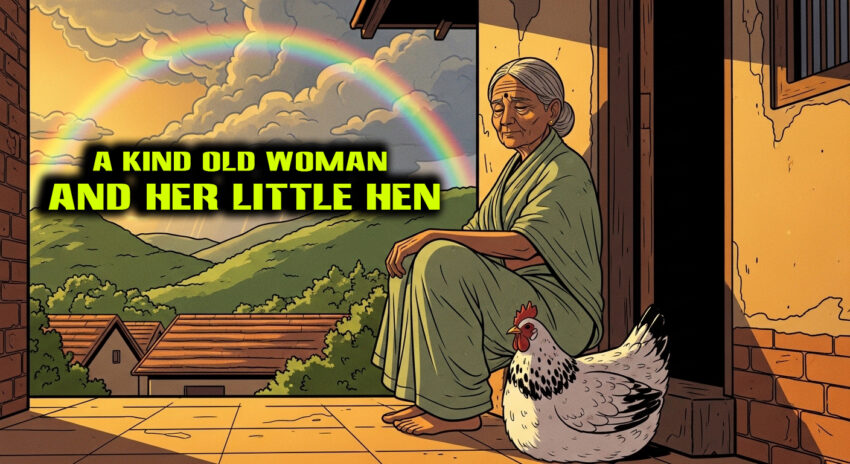
In a small town cradled by green hills and a gentle stream, there lived an elderly woman named Amma. Her home was a modest cottage at the edge of the village, wrapped in a quiet garden of vegetables and fruit trees. A wooden fence bordered her little world, its planks sighing softly in the breeze as if keeping her secrets.
Amma had no children, and her husband had passed many years ago. Yet she was never truly alone. She had Poppy — a small, proud hen with soft white feathers, neat black spots on her wings, and a bright red comb that bobbed when she walked. Poppy was more than a pet. She was a companion, a shadow, a friend. She followed Amma through the garden, across the yard, and along the dusty village paths, clucking gently as though offering her own quiet opinions on the matters of the day.
The villagers loved the sight of them together — Amma walking slowly with her wooden cane, and Poppy waddling faithfully beside her like a small, feathered dignitary.
Every morning, as the sky bloomed orange and pink with the rising sun, Poppy would lay one warm, smooth egg. Amma would collect it carefully, holding it in her wrinkled hands as though it were something precious. She would whisper softly, “One is enough, my dear. May we always have just what we need.”
She would boil the egg, eat half for breakfast, and save the rest for dinner. She tended her garden, grew her own vegetables, and lived with a deep, untroubled peace in her heart.
Then one morning, something changed.
Poppy laid two eggs.
Amma blinked, looked at the nest, then at Poppy. “Two?” she whispered. “Well, now that is generous.”
She cooked one egg for herself and carried the second to the market, asking for nothing more than a handful of rice and a small piece of jaggery. It was simple. It was enough.
The days passed, and Poppy continued laying two eggs each morning without fail. Word spread through the village. Neighbours arrived at Amma’s gate with advice.
“Sell both eggs, Amma! Keep nothing back.”
“Feed Poppy more. Perhaps she’ll lay three!”
“Think bigger. Ten hens, a proper business — you could be wealthy!”
But Amma only smiled her warm, unhurried smile. “One for me,” she said, “and one to share. That is enough.”
The second egg went to a struggling family down the lane, to hungry children walking home from school, or was left silently on a neighbour’s doorstep before dawn. The villagers began calling her Egg Amma, with great affection and a fondness that only grows for those who give without keeping score.
Then the monsoon arrived.
The rains fell hard and heavy for many days. The stream swelled and overflowed its banks. Fields were flooded, crops were lost, and many families found themselves with very little to eat. Times grew difficult across the village.
But Poppy kept laying her two eggs each morning, steady as sunrise. And Amma, who had been quietly saving and pickling and preserving for weeks, began moving through the village with baskets of boiled and pickled eggs, knocking on doors, leaving food on steps, asking for nothing in return.
One rainy afternoon, a group of villagers gathered at her cottage. “Amma,” said one of them gently, “why did you not sell more when times were good? Why did you not try to make more money while you had the chance?”
Amma was quiet for a moment. She looked at them with kind, steady eyes.
“Because true happiness,” she said at last, “is not about gathering more. It is about loving what we already have — and sharing it when the time comes. I kept only what I needed. Everything else was a gift meant to be passed on.”
Poppy clucked softly and nestled against Amma’s feet, as if in full agreement.
And the villagers stood in the rain, understanding at last what Amma had always known — that a life lived in gratitude and generosity is the richest life of all.